Ag Marketing Shifts as AI Adoption Hits 17%, Payment Stalls at 4%
Just another WordPress site
Press Release Disclaimer: This is a press release distributed through the XPR Media network. It has not been independently verified by our newsroom.


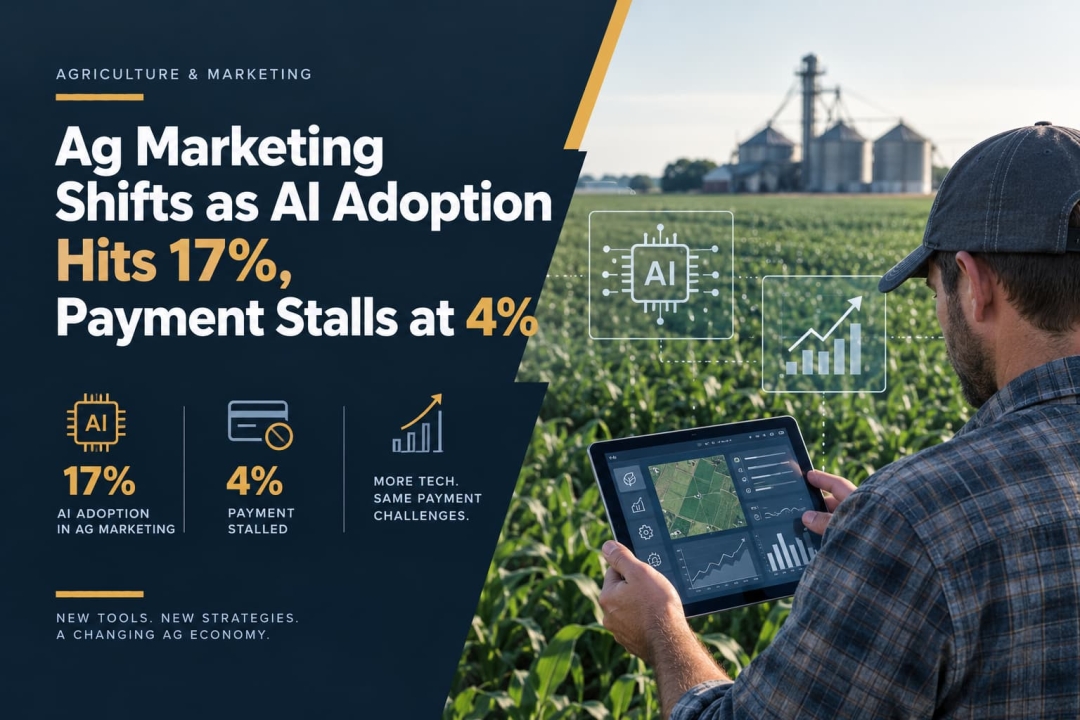
MELBOURNE, Australia – October 17, 2026 – Global farmer adoption of generative AI has reached 17%, yet only 4% of farmers pay for AI tools, according to McKinsey & Company’s Global Farmer Insights 2026. The 13-percentage-point gap between experimentation and payment, identified in a new Farm Table analysis of Australian agribusiness positioning, reveals a critical challenge for companies selling AI-powered tools to the agricultural sector.
The McKinsey survey of 5,500 farmers across 10 countries found that while AI adoption is accelerating, farmers remain selective about spending and demand demonstrable returns. This mirrors broader precision agriculture trends: 54% of North American farmers plan additional precision technology investment within two years, but cite cost (56%) and ROI uncertainty (36%) as primary barriers.
Three Surprising Findings
1. The Free Rider Problem: 70% of AI Users Pay Nothing
While 17% of farmers globally use generative AI for farm-related tasks, only 4% pay for tools, roughly 12% use free versions. This “try-before-buy” dynamic differs fundamentally from traditional agtech hardware adoption and signals massive untapped monetization potential.
2. Trust Still Lives With Humans, Not Algorithms
Only 6% of farmers cite Gen AI chatbots as a trusted advice source, compared to 56% who rely on agronomists. AI is being used for research and planning, but farmers validate critical decisions with human experts before committing capital.
3. The “Pilot Trap” Is Documented and Systemic
The World Economic Forum warns that many agricultural AI initiatives “shine in a pilot and then stall” under commercial conditions. The barrier is “rarely the algorithm. It is the workflow.” AI must “pay for itself, fast” and deliver “measurable value within a season, not a multi-year data strategy.”
Key Statistics
-
17% of global farmers use generative AI for farm-related tasks (McKinsey Global Farmer Insights 2026).
-
4% of farmers pay for AI tools; 12% use free versions (McKinsey Global Farmer Insights 2026).
-
26% adoption in Latin America, the highest regional rate reported (McKinsey Global Farmer Insights 2026).
-
23% adoption among North American farmers (McKinsey Global Farmer Insights 2026).
-
Approximately 75% of farmers expect AI to impact operations within 3–5 years (McKinsey Global Farmer Insights 2026).
-
6% of farmers cite Gen AI as a trusted advice source, compared to 56% who rely on agronomists (McKinsey Global Farmer Insights 2026).
-
43% of farmers use Gen AI for planning; 33% for crop management (McKinsey Global Farmer Insights 2026).
-
54% of farmers plan additional precision technology investment within two years (CNH Farmer Pulse Report, August 2026).
-
89% of North American farmers use auto-guidance technology (CNH Farmer Pulse Report, August 2026).
-
$4.86 billion – AI in agriculture market size in 2026; projected to reach $13.57 billion by 2030 (Research and Markets, January 2026).
What This Means for Australian Agribusinesses
Trust remains the critical barrier. Only 6% of farmers cite Gen AI as a trusted advice source, compared to 56% who rely on agronomists. Australian agribusinesses selling AI-powered tools must lead with seasonal ROI and expert validation, not technological capability.
The World Economic Forum has identified the “pilot trap” as a systemic barrier: agricultural AI initiatives succeed in demonstrations but stall under commercial conditions. WEF notes that AI must “pay for itself, fast” and deliver “measurable value within a season, not a multi-year data strategy.”
The gap between 17% adoption and 4% paid conversion is a positioning challenge, not a demand problem. Australian farmers are curious, but they’ve been burned by technology promises before.
“The data tells us farmers are experimenting with AI at remarkable speed, but they’re not opening their wallets yet,” said Airlie Trescowthick, Founder of Farm Table. “That’s not resistance, it’s rational. Australian farmers have been burned by technology promises before. Agribusinesses’ job isn’t to convince them AI is exciting. It’s to prove it pays for itself within a season.”
“The winners in this market will be the ones who make AI feel less like a gamble and more like a tool they can’t farm without,” said Airlie Trescowthick, Founder of Farm Table. “That requires proving value in one season, not promising transformation in five.”
“The next chapter of precision agriculture will be defined by making technology easier to use, easier to trust, and easier to prove its value,” said Eric Shuman, Global Product Management, Precision Technology at CNH. “The opportunity now is to remove the barriers that slow adoption by delivering solutions that are intuitive, reliable, and built around the realities of farming.”
Q&A
Q: How many farmers use AI in agriculture in 2026?
A: Approximately 17% of farmers globally use generative AI for farm-related tasks, according to McKinsey & Company’s Global Farmer Insights 2026.
Q: Why do so few farmers pay for AI tools?
A: Only 4% pay for AI tools because farmers require proof of seasonal ROI before committing operating capital. An additional 12% use free versions, a “try-before-buy” dynamic.
Q: What is the AI in agriculture market size in 2026?
A: The market is valued at $4.86 billion in 2026 and is projected to reach $13.57 billion by 2030, according to Research and Markets.
Q: Why do farmers trust agronomists more than AI?
A: Only 6% of farmers cite Gen AI as a trusted advice source, compared to 56% who rely on agronomists, according to McKinsey. AI is used for research and planning, but farmers validate critical decisions with human experts.
Q: What percentage of farmers plan precision technology investment?
A: 54% of farmers plan to invest in additional precision technology within two years, according to the CNH Farmer Pulse Report.
Methodology
This Farm Table analysis draws on McKinsey & Company’s Global Farmer Insights 2026 (5,500 farmers across 10 countries, April–July 2026), the CNH Farmer Pulse Report (217 farmers across U.S. and Canada, May 2026), and market forecasts from Research and Markets (January 2026). The World Economic Forum provided strategic context on AI scaling challenges in agriculture.
About Farm Table
Farm Table is an independent Australian agricultural knowledge platform and digital marketing agency founded by Airlie Trescowthick. The organization connects producers, agribusinesses, and industry organizations through its knowledge hub and provides digital marketing, content distribution, and go-to-market support for the agricultural sector.
For B2B agricultural marketing support: https://farmtable.com.au/agricultural-marketing-agency-for-b2b/
Full study available at: Ag Marketing Enters New Phase as AI Moves Beyond the Pilot Trap
Media Contact
Company Name: Farm Table
Contact Person: Airlie Trescowthick
Email: Send Email
Phone: 03 7044 2185
Address:Two Melbourne Quarter, Ground Floor, 697 Collins Street
City: Docklands
State: Victoria 3008
Country: Australia
Website: https://farmtable.com.au/
Press Release Distributed by ABNewswire.com
To view the original version on ABNewswire visit: Ag Marketing Shifts as AI Adoption Hits 17%, Payment Stalls at 4%
Media gallery